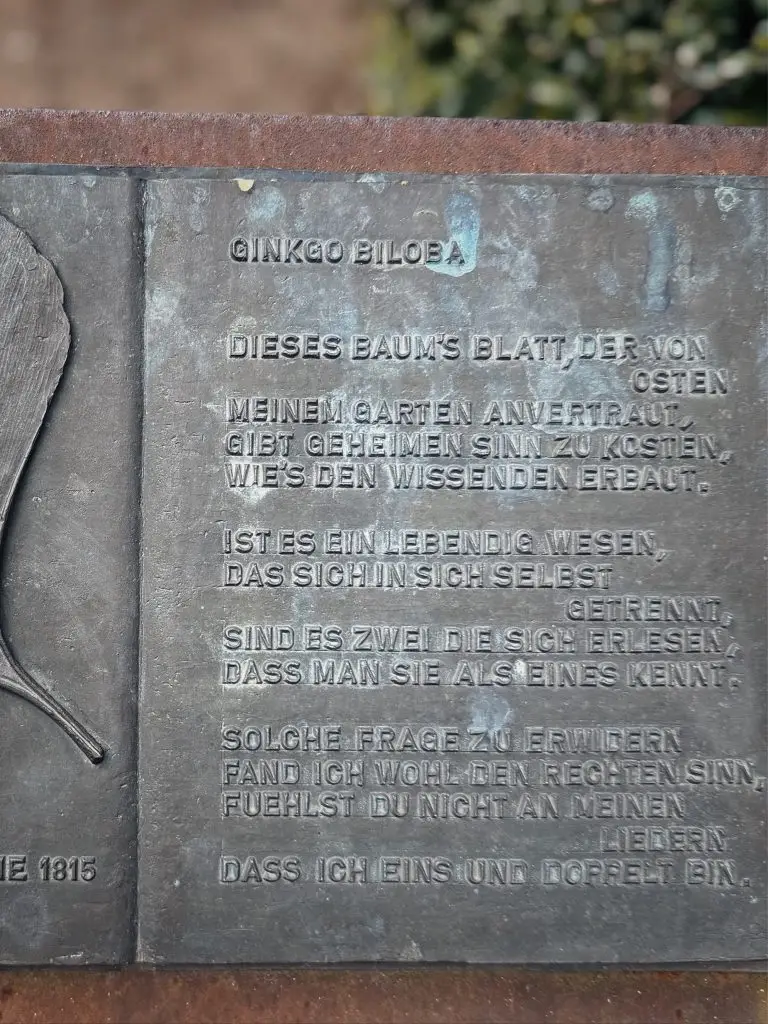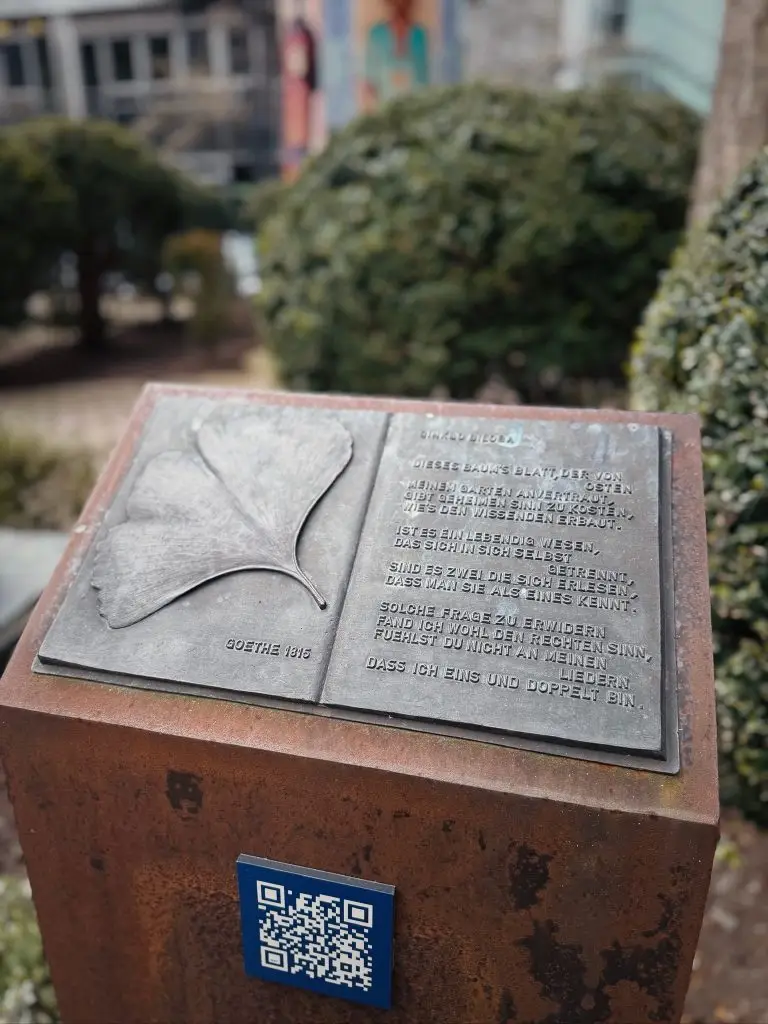
At the edge of the path, under the protective canopy of a ginkgo tree, stands a narrow stele made of Corten steel. It does not impose; it waits as a silent companion for those who are ready to look beyond the visible form of things. Resting upon it is the bronze plaque by Eberhard F. Gutberlet, which resembles an open book of natural history, capturing the delicate structure of the ginkgo leaf for eternity.
Right next to the leaf, verses from Goethe's „West-Eastern Divan“ are deeply inscribed in the bronze. It is this immediate proximity of natural form and lyric poetry that makes the plaque so lively. Goethe's lines revolve around the existential question of unity in duality: Is it one being that has separated itself within itself, or is it two that we recognize as one? The poem offers no definitive answer, but rather describes a tension that becomes palpable in the firm anchoring of the stele and the play of light and shadow on the metal.
Gutberlet's work on the 25 x 32 cm panel foregoes any staging. The earthy patina of the bronze and the warm, rusty tone of the Corten steel enter into a symbiosis with the changing light that filters through the branches. Those who pause here encounter a poetic anchor point that invites us not to prematurely resolve contrasts, but to understand „one and double“ as a necessary part of a greater whole.